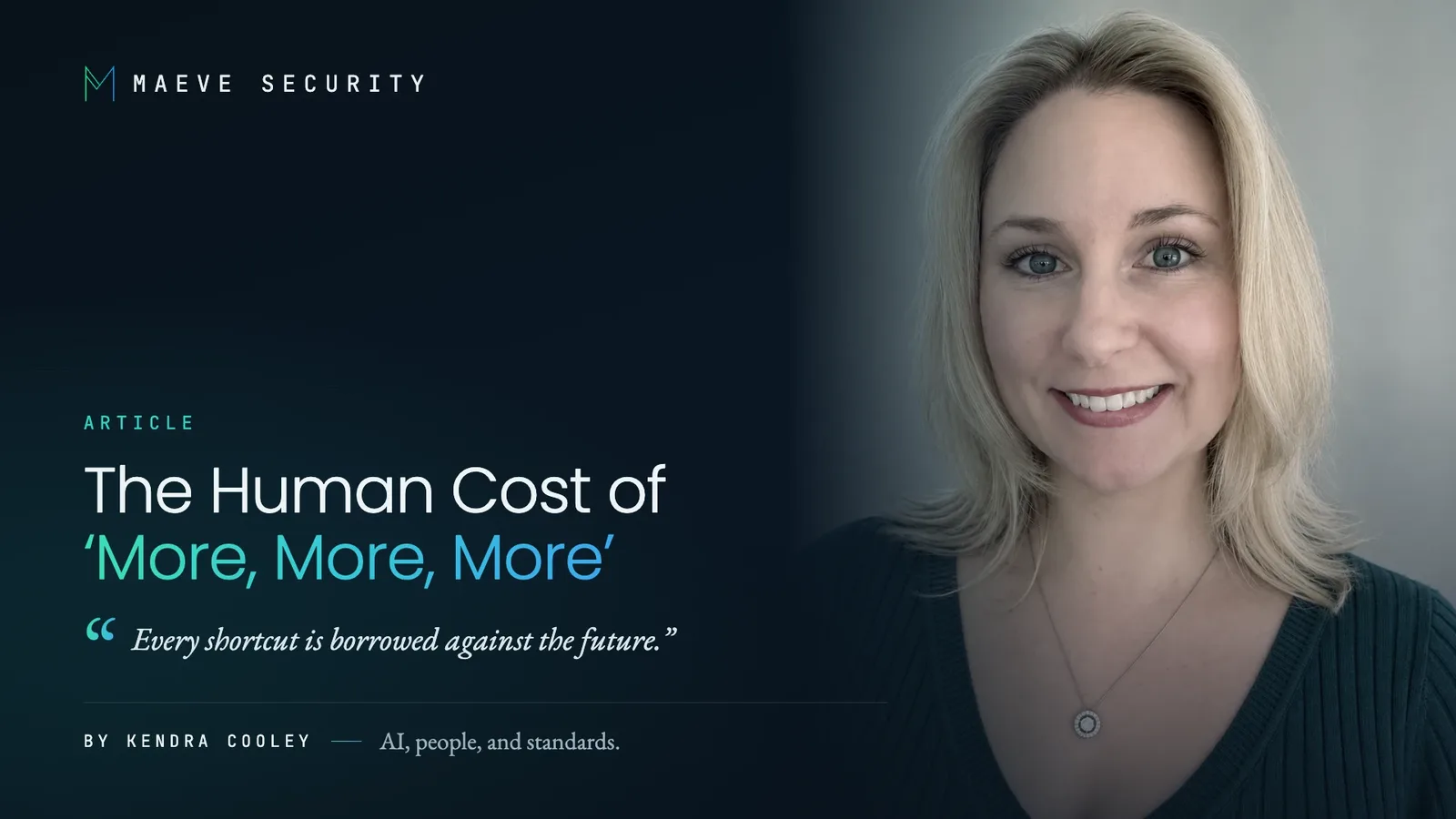
 Kendra Cooley. Image: Maeve Security.
Original article on Maeve SecurityThe Human Cost of ‘More, More, More’maevesecurity.com ↗
Every shortcut is borrowed against the future.
Earlier this week, I came across a post from an engineer describing what their career has turned into. As I read, I could feel this person’s passion for a career they once loved being stripped away from them line by line. So much of it resonated with me, because I’ve watched the same thing happen up close for the last several years.
I’ll start with something I witnessed firsthand. Three engineers, none of whom were working together, each built a new tool. Two had similar products in mind and the third was working on something completely different. The end result: three tools with the exact same look and feel. That’s not a knock on any of them. What they built was incredibly impressive, especially considering how quickly they had a functioning product. But when I shared the original post on LinkedIn, one commenter pointed out this exact thing: two independent engineers ending up with nearly identical applications because the same models are doing the work under the hood. I laughed, because I’d seen it.
As a security person, I know what “identical” really means. It isn’t just the buttons and color schemes that look the same. It’s the code underneath with the same patterns, the same dependencies, the same mistakes, repeated across thousands of companies at once. When everyone’s code is written by the same handful of models, a single weakness doesn’t live in one app - it’s everywhere.
Before we get too far into the weeds, I want to be clear that I believe these AI tools have a place in this world. I’ve seen the speed at which they let companies build truly incredible technology. I’ve also talked with people who lost their jobs to downsizing in favor of AI. I see the good and the bad, and I sit pretty firmly in the middle.
So if the tools all produce the same output, what will set these products and businesses apart? For me, the answer is simple: people.
Unfortunately, people are becoming expendable at a rapid rate. Echoing the original poster, we are being turned into button pushers. Companies want more, more, more, and the pace leaves little to no time to read, think critically, or verify what these tools produce. The result is significant burnout across our industry. In my repost I called it a race to the bottom: quantity over quality, and a willingness to cut standards for the sake of a dollar. The original poster described it as “soul-sucking,” and I feel that to my core.
Most people who know me know I found my way into cybersecurity by accident. I had an incredible manager who took a chance on me when I was his administrative assistant, and I started my career in identity and access management. Nothing glamorous, but it was a chance to learn something new. It wasn’t until a couple of years in, when I got to create the content for that year’s National Cybersecurity Awareness Month, that I truly found my passion. It finally clicked: at the heart of security is people. We do this job to protect people. A breach can destroy not only a company, but also the livelihoods of everyone who works there. I’ve carried the weight of that ever since, and I take it very seriously.
Lately, I’ve felt that passion start to slip. For the last several years, I’ve been in positions that put me in the driver’s seat of security programs, and across the industry I’m watching security leaders get asked to compromise on best practices for the sake of speed. Give the AI agent admin access so it can “just work.” Merge the generated code without a real review. Loosen the data controls so the new tool can connect to everything. Skip the approval process because the business can’t wait.
My original start in security working in IAM makes this one especially hard to watch. Every one of these AI agents is an identity. It has access, it takes actions, and it needs an owner and proper oversight. Yet we’re handing them standing permissions we’d never give a new employee, often with little logging and no one responsible for reviewing what they can reach. We spent years building least privilege and access reviews to prevent the kinds of breaches that cost people their jobs, and now we’re being asked to poke holes in all of it for tools most organizations haven’t taken the time to govern. The problem isn’t that no one understands the risks. It’s that security teams are being left without visibility into how these tools are actually deployed, and are being asked to patch the gaps after the fact.
I know this is a polarizing topic. Some feel strongly that if you don’t jump on the AI bandwagon, you’ll be left behind. Others believe those who rely too heavily on these tools will forget how to think or do anything on their own. In my opinion, the companies that prosper will be the ones that embrace these technologies safely and effectively while holding on to the fundamentals and keeping people at the core of their business. Those that automate every aspect of their business may look like they’re ahead at first. But every shortcut is borrowed against the future and your unreviewed code becomes tomorrow’s vulnerabilities, agents with excessive permissions become tomorrow’s breach, and the expertise they stopped investing in won’t be there when they need someone to clean it up.
So what can we actually do today to try to slow the bleed?
- Treat AI agents like identities. Give them owners, least-privilege access, logging, and a regular access review like you would a person.
- Keep a human in the loop where it matters. Generated code and automated changes to production systems still need some level of review.
- Make risk acceptance visible. If the business decides to move faster than security recommends, that decision needs to be documented and owned by leadership, not quietly shouldered by the security team.
- Give people time to think. Build verification time into the speed you’re expecting. Speed without some scrutiny isn’t efficiency.
Finally, I’m left wondering as companies keep spending more in pursuit of more, and as people lose their passion and the fundamentals of their craft, what will the true cost of all this be? I suspect part of the answer will show up in breaches we haven’t had yet. Part of it will show up in the people we burn out. And part of it will show up years from now, when we realize we stopped training the juniors who were supposed to become our seniors.
My gut says we all still have a lot to learn about how our world is changing in this new AI reality. My only hope is that as we keep pushing forward, we don’t forget to take care of each other.
Sources
- The Human Cost of ‘More, More, More’ maevesecurity.com ↗
- The Human Cost of More (original LinkedIn post) linkedin.com ↗